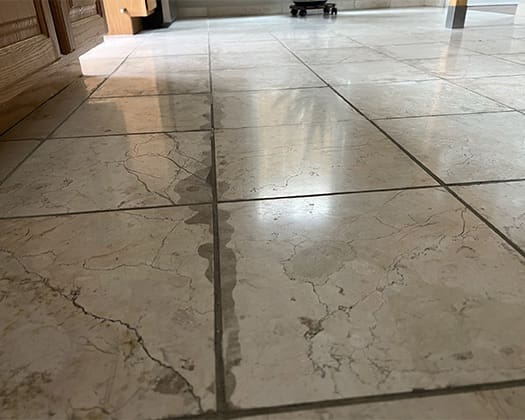
Travertine is prized for its natural beauty, but one characteristic that often surprises homeowners is the presence of holes and pits throughout the stone. While many of these holes are filled during manufacturing, it’s not uncommon for filler to wear away over time, leaving visible voids in the floor.
Fortunately, holes in travertine can often be repaired without replacing the tile. Understanding what causes these holes and how they’re repaired can help you determine the best solution for your floor.
Why Do Holes Appear in Travertine?
Travertine forms when mineral-rich water deposits layers of calcium carbonate around hot springs and underground water sources. As gases escape during formation, natural voids are left behind in the stone.
Many travertine tiles are sold as “filled travertine,” meaning these holes have been filled with a cementitious or resin-based material at the factory. Over time, however, normal foot traffic, cleaning chemicals, moisture, and wear can cause the filler to loosen or fall out.
The result is often small holes that collect dirt and become more noticeable over time.
Can Holes in Travertine Be Repaired?
Yes.
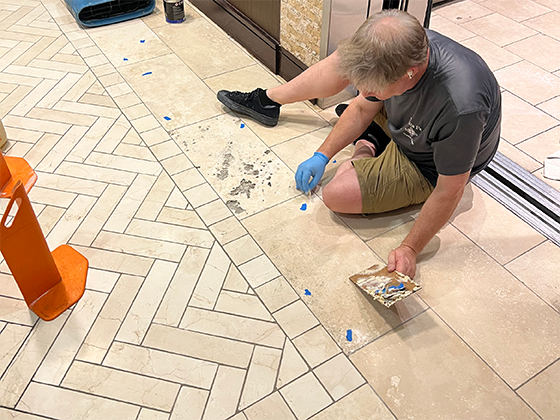
Most holes in travertine can be repaired using specialized fillers designed to bond with natural stone. The repair process typically involves cleaning the damaged area, filling the void, and blending the repair to match the surrounding stone.
The success of the repair depends on:
- The size of the hole
- The condition of the surrounding stone
- The type of filler used
- Whether the floor will be honed or polished afterward
What Materials Are Used to Repair Travertine?
Several materials are commonly used depending on the size and location of the damage.
Polyester Fillers
Polyester fillers are one of the most common materials used in professional travertine restoration. They cure quickly and can often be color matched to blend with the surrounding stone.
These fillers are frequently used for:
- Small holes
- Missing factory filler
- Surface pits
- Minor chips
Epoxy Fillers
Epoxy fillers provide excellent strength and durability and are often used for larger repairs.
Benefits include:
- Strong bonding characteristics
- Excellent durability
- Good color-matching options
- Resistance to moisture
Grout-Based Repairs
For larger voids or rustic travertine installations, color-matched grout may sometimes be used to fill holes.
This approach is often found in older floors where a more natural appearance is desired.
How Professionals Repair Holes in Travertine
Professional travertine repair typically follows several steps:
Step 1: Deep Cleaning
The damaged area is thoroughly cleaned to remove dirt, oils, and contaminants that could interfere with the repair.
Step 2: Remove Loose Material
Any failing filler or loose stone is removed to create a stable surface for the new repair material.
Step 3: Fill the Holes
A color-matched filler is carefully applied to the damaged area and allowed to cure.
Step 4: Hone the Surface
Once cured, the repair is honed flush with the surrounding stone using diamond abrasives.
Step 5: Polish and Blend
If the floor has a polished finish, the repaired area is polished to match the surrounding surface.
Step 6: Seal the Stone
An impregnating sealer may be applied to help protect the travertine from future staining and moisture intrusion.
DIY Travertine Hole Repair
Small holes can sometimes be repaired by homeowners using stone repair kits available online or at specialty stone supply stores.
However, DIY repairs can be challenging because:
- Color matching is difficult
- Repairs may remain visible
- Excess filler can damage the surrounding finish
- Honing and polishing equipment is often required
For highly visible areas, professional repairs typically produce the best results.
When Should Missing Filler Be Repaired?
Repairing missing filler is recommended when:
- Holes are collecting dirt
- The floor feels rough underfoot
- Pits are becoming larger
- Moisture is entering the stone
- You are preparing for honing or polishing
Addressing these issues early can prevent additional wear and help maintain the appearance of the floor.
Can Old Travertine Floors Be Fully Restored?
In many cases, yes.
Even heavily worn travertine floors can often be restored through a combination of:
- Hole and pit repairs
- Deep cleaning
- Honing
- Polishing
- Sealing
Professional restoration can dramatically improve the appearance of older travertine while preserving the natural character that makes the stone unique.
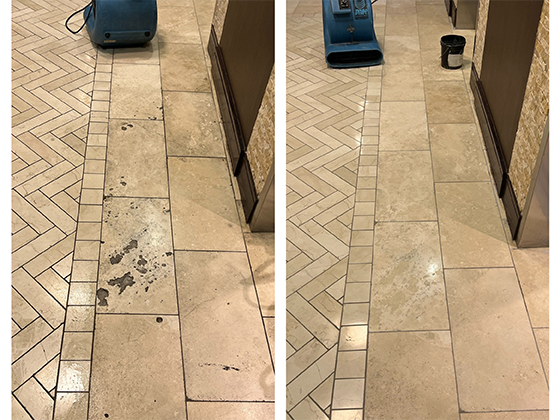
Proof: Real Travertine Restoration Results in Austin
We’ve repaired and restored travertine floors throughout the Austin area, including projects involving missing filler, etching, traffic wear, and dull finishes.
See examples of our:
Check out the project on google, Facebook, and Instagram
These projects demonstrate how proper repairs and restoration techniques can bring worn travertine back to life.
We Are Austin’s Complete Floor & Surface Care for Your Home
If you’re looking for more ways to protect and restore your floors, we offer a full range of professional services designed to keep every surface in your home looking its best. From deep tile and grout cleaning and long-lasting grout recoloring services, to advanced carpet cleaning and targeted pet urine treatment, we handle the toughest cleaning challenges with proven methods. We also provide detailed upholstery cleaning and gentle yet effective wood floor cleaning to refresh your entire living space.
For natural stone, our specialized stone restoration services cover everything from travertine cleaning, marble cleaning, and terrazzo services to limestone services and slate services. If your floors have lost their shine, our natural stone honing and polishing process can restore a smooth, like-new finish. Explore each service to learn more about how we can bring your floors back to life.
Travertine Cleaning, Repair, and Restoration in Austin, Texas
Whether your travertine has holes, etching, dull spots, stains, or years of wear, professional restoration can often bring it back to life without the cost of replacement.
At Santa Fe Floor Cleaning & Stone Care, we specialize in travertine cleaning, hole repair, honing, polishing, sealing, and full travertine restoration throughout Austin, Round Rock, Georgetown, Cedar Park, Lakeway, West Lake Hills, and surrounding communities.
If you’d like an expert opinion on your travertine floors, we’re happy to help.
👉 Visit our website to learn more about our travertine restoration services and view recent project photos.
👉 Request an estimate online using our simple contact form.
👉 Call or text us to discuss your travertine floors and get answers to your questions.
Our team can help determine whether your travertine needs cleaning, repair, honing, polishing, sealing, or complete restoration.
We Are Austin’s Complete Floor & Surface Care for Your Home
If you’re looking for more ways to protect and restore your floors, we offer a full range of professional services designed to keep every surface in your home looking its best. From deep tile and grout cleaning and long-lasting grout recoloring services, to advanced carpet cleaning and targeted pet urine treatment, we handle the toughest cleaning challenges with proven methods. We also provide detailed upholstery cleaning and gentle yet effective wood floor cleaning to refresh your entire living space.
For natural stone, our specialized stone restoration services cover everything from travertine cleaning, marble cleaning, and terrazzo services to limestone services and slate services. If your floors have lost their shine, our natural stone honing and polishing process can restore a smooth, like-new finish. Explore each service to learn more about how we can bring your floors back to life.
Looking for a trusted commercial floor cleaning company in Austin? Santa Fe Floor Cleaning & Stone Care provides professional tile & grout, carpet, upholstery, wood, and natural stone cleaning for offices, retail spaces, churches, HOAs, and apartment communities.
Contact Santa Fe Floor Cleaning & Stone Care today and discover why Austin homeowners trust us with their natural stone floors.