You love your pets — but that smell in your carpet? Not so much. If you’ve tried sprays, scrubbing, or even renting a machine, you already know the pattern: you get rid of the pet odor in your carpet, and it comes back a few weeks later. If you’re trying to remove pet odor from carpet in Austin, here’s the truth most cleaning products won’t tell you — most methods never reach the source of the problem.
Why Pet Odor Keeps Coming Back
Pet urine isn’t just on the surface. It spreads deep into multiple layers:
- Carpet fibers
- Carpet backing
- Padding underneath
- Sometimes the subfloor itself
The Carpet and Rug Institute’s technical bulletin on pet urine notes that some carpet backings are designed specifically to resist spills penetrating into the cushion and subfloor beneath — which tells you plainly how far untreated urine can travel when that backing isn’t present or has already been compromised. That’s why the smell comes back after drying, stains reappear through wicking, and odor can actually get worse over time rather than better.
Why DIY Cleaning Doesn’t Work
Most homeowners unknowingly make the problem worse without realizing it.
Surface Cleaning Only Hits the Top
Store-bought products and rental machines don’t have the power to extract contamination from the deeper layers where the odor is actually living.
Residue Can Make It Worse
Many consumer cleaners leave behind a sticky residue that attracts more dirt and traps odor rather than releasing it.
Moisture Reactivates Old Odor
Urine leaves behind salts and crystals that reactivate when humidity rises — a particular problem in Austin’s climate. The same Carpet and Rug Institute bulletin points out that many odor-control products only mask the smell temporarily, and that the odor is prone to reappear in humid conditions — exactly the cycle Austin homes tend to see.
The Real Problem: Bacteria and Urine Crystals
When urine dries, it leaves behind salts and crystals bonded to the carpet. When moisture reaches them again, odor reactivates, bacteria multiply, and that ammonia smell returns — which is why a carpet can sometimes smell worse after a DIY cleaning attempt than before it.
Why Shampooing Can Make Odors Worse
Shampooing is one of the most common mistakes homeowners make with pet odor. It tends to push contamination deeper into the pad, leave behind soap residue, and fail to fully extract the moisture it introduces — often resulting in a stronger odor once the carpet dries.
What Actually Works: Professional Pet Odor Removal
To genuinely fix the problem, the contamination has to be flushed and extracted from every layer it’s reached, not just treated on the surface.
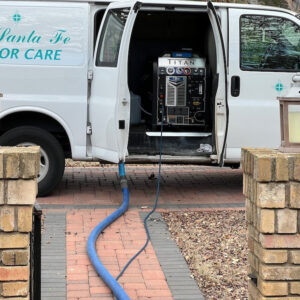
Hot Water Extraction
Professional truck-mounted systems use heat, pressure, and vacuum power together to break up urine contamination, rinse deep into the carpet and pad, and extract everything back out. The IICRC’s S100 Standard governs professional cleaning of textile floor coverings like carpet for exactly this reason — it’s an established, tested process, not a shortcut.
Enzyme Treatments
Enzyme-based solutions work differently than surface cleaners: they break down urine at the molecular level and target the bacteria directly, rather than simply masking odor. That’s the real distinction between temporary deodorizing and true odor elimination.
The Professional Process
-
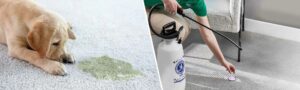
Here’s how a real pet odor removal service actually works:
- Inspection — identify affected areas and how deep the contamination goes
- Targeted Treatment — apply urine-specific neutralizers to the identified areas
- Deep Flush Extraction — a truck-mounted system rinses and removes the contamination from every layer
- Final Neutralization — confirm no odor remains before we consider the job done
Ensure no odor remains
When Carpet Replacement Is Necessary
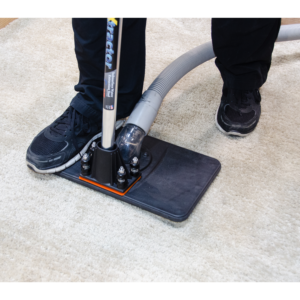
Sometimes the damage is too deep to fully reverse. If urine has reached the subfloor, odors may never fully resolve and the padding may need to be replaced. Signs worth watching for include a strong odor that persists even after cleaning, repeated issues in the same spot, or long-term staining. A professional inspection can usually tell you which situation you’re dealing with fairly quickly.
Why This Is a Bigger Problem in Austin
Austin homes deal with a combination of humidity, heat, and active pets tracking in mud and moisture — and that combination is exactly what drives the odor-reactivation cycle described above. It’s one of the reasons pet odor complaints in this area tend to be more persistent than in drier climates.
Removing Pet Odor From Carpet in Austin — The Right Way
If you’ve been fighting the same smell over and over, it isn’t because you’re doing something wrong — it’s because the source hasn’t been removed yet. At Santa Fe Floor Cleaning & Stone Care, we use truck-mounted hot water extraction and professional-grade enzyme treatments to eliminate pet odor at the source rather than mask it. For a broader look at keeping carpet in good shape between visits, see our guide on how often carpet should be cleaned in Austin, TX.
We Are Austin’s Complete Floor & Surface Care for Your Home
Beyond pet odor and urine treatment, we offer a full range of professional services to keep every surface in your home looking its best — from deep tile and grout cleaning and long-lasting grout recoloring, to carpet cleaning and upholstery cleaning. For natural stone, our stone restoration services cover travertine, marble, limestone, terrazzo, and slate.
If you’re dealing with pet odor that keeps coming back no matter how much you clean, call us at (512) 632-1621 or request a quote online — we’ll assess what’s actually happening beneath the surface and get rid of it for good.